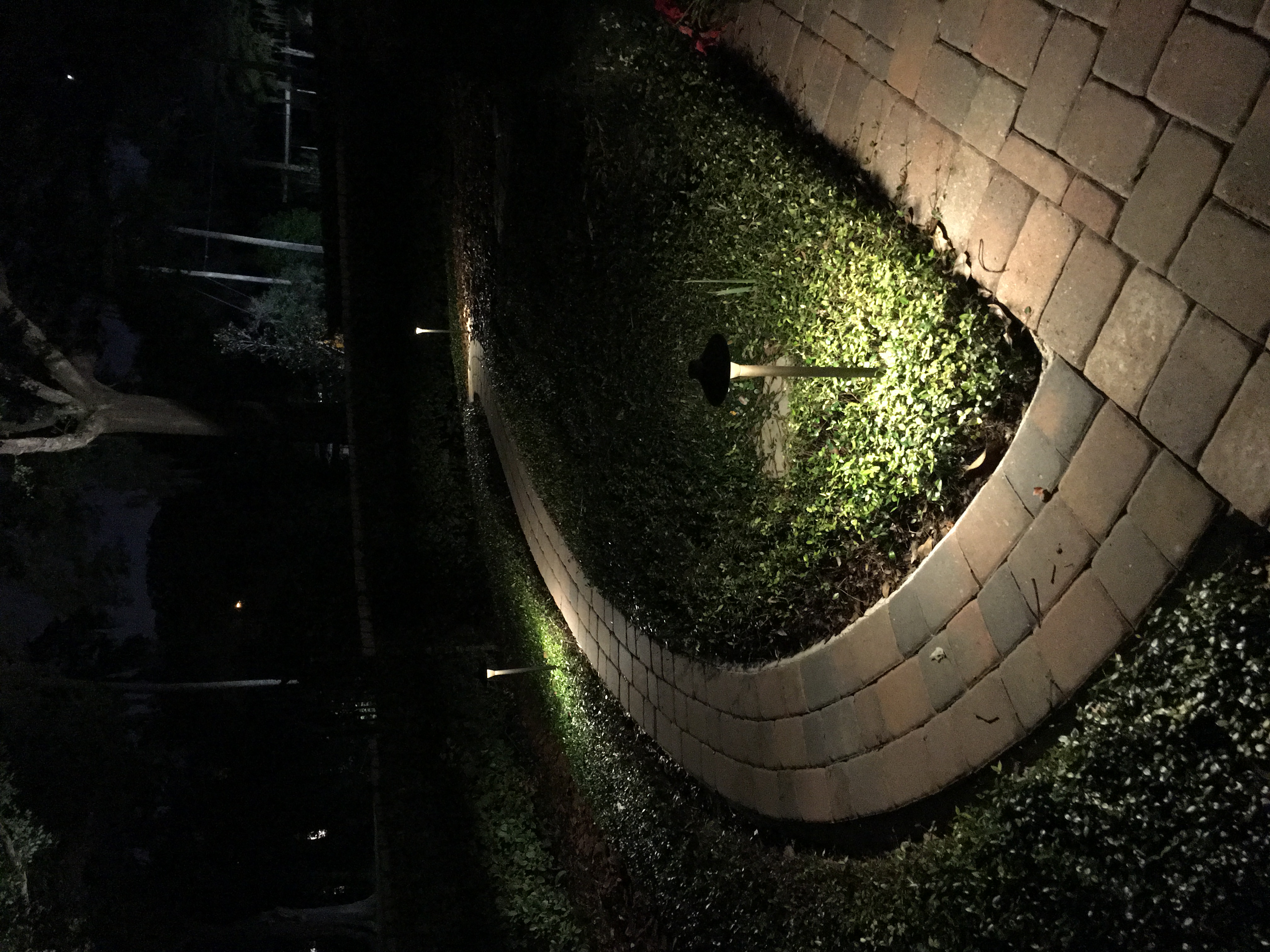
Garden path lighting is easier to over-do than under-do. The impulse — understandable — is to ensure everything is visible and no step is missed in the dark. The result, in practice, is a sequence of bright pools with dark gaps between them that the eye finds harder to navigate than a dimmer, more even distribution. The light is also often aimed in the wrong direction: at the fixture housing itself rather than across the path surface.
What pathway lighting actually needs to do
The functional requirement is modest: enough light to see the path edge, read the surface texture and anticipate any level change. For a standard garden path at 0.9–1.2 m wide, 50–100 lux at ground level is sufficient. That is considerably less than the 300 lux a typical interior hallway has — outdoor eyes adapt, and the contrast with surrounding darkness means lower light levels read as brighter than equivalent levels indoors.
The atmosphere requirement is harder to quantify but usually points in the same direction: less is more. A path that vanishes slightly into shadow beyond each light draws the eye forward. A path that is uniformly bright offers no visual depth.
Fixture spacing
The conventional starting point is to space fixtures at a distance equal to roughly three times the mounting height. A bollard light at 45 cm height would then be placed every 1.35 m — but that is a density that most residential gardens do not need and most paths cannot absorb without looking cluttered.
A more practical approach: space fixtures at 2–3 m intervals and use a fixture with a wider beam distribution rather than a tight spot. The goal is overlapping cones of light at ground level, not adjacent pools. For a 12 m path, that means four to six fixtures, not ten.
Colour temperature
LED path fixtures are available across the range from 2700 K (warm white, similar to incandescent) to 6500 K (daylight-blue, comparable to overcast sky). For residential gardens, the range 2700–3000 K is almost universally appropriate. Warmer light reads as welcoming, integrates with planting better and causes less disturbance to nocturnal wildlife — a consideration that has received increased regulatory attention under Polish and EU guidance on light pollution from the early 2020s onward.
Colour rendering index (CRI) matters more in planting-adjacent contexts than is often recognised. A fixture at CRI 80 will render foliage convincingly enough; at CRI 70 and below, greens shift toward grey and the relationship between the lit path and the surrounding plants becomes visually disconnected.
Power supply options
For residential garden paths, the two realistic options are mains-voltage (230 V) installation with a dedicated outdoor circuit and low-voltage (12 V) systems using a transformer.
Mains voltage requires a licensed electrician and, in Poland, compliant installation under PN-IEC 60364 — specifically the requirements for outdoor zones classified as Zone 0, 1 or 2 depending on proximity to water features. It offers the widest fixture choice, unlimited cable runs and highest reliability.
Low-voltage systems are less expensive to install, can be extended without specialist work and are safer to handle when adjustments are needed. The limitation is cable run length — at 12 V, voltage drop over 15–20 m of cable is significant enough to affect light output unless oversized cable cross-section (4 mm² rather than the standard 1.5 mm²) is used throughout.
Solar-powered path lights are widely available and increasingly reliable in terms of the LED components themselves. The persistent limitation is battery capacity in Polish winters: at latitudes between 49° and 54° N, winter day length and solar irradiance are insufficient to fully charge even a good-quality panel in overcast conditions. Expect solar fixtures to perform noticeably less well between November and February, which is precisely when reliable path lighting matters most.
Fixture selection and IP rating
Any fixture installed in a garden path should carry a minimum IP65 rating — fully dust-tight and resistant to direct water jets. For in-ground or recessed fixtures, IP67 (submersion to 1 m) is more appropriate given that they may sit in standing water after heavy rain or snowmelt.
The choice between bollard lights, recessed in-ground fixtures, wall-mounted downlights and spike-mounted spotlights is partly functional and partly a matter of the garden's character. Bollards draw attention to themselves; recessed in-ground lights are nearly invisible until lit. Spike-mounted fixtures are flexible and easy to relocate but tend to settle or tip on sandy or loose soils — the spike needs to be set in concrete collar for stability on Polish sandy glacial deposits.
Polish standard PCA certification and CE marking apply to all commercially available outdoor electrical fixtures sold in Poland. Always verify that fixtures are rated for outdoor use; indoor IP20 fixtures are occasionally incorrectly sold for garden applications and will fail rapidly when exposed to moisture.
A note on light pollution
The European Commission's dark sky awareness framework and Poland's environmental regulations increasingly restrict the use of high-lumen upward-facing lights in residential areas. Path lighting that directs its output downward onto the path surface — rather than laterally or upward — avoids this issue entirely and is also more efficient per installed watt. When specifying fixtures, prefer those with a full-cutoff or semi-cutoff light distribution profile.