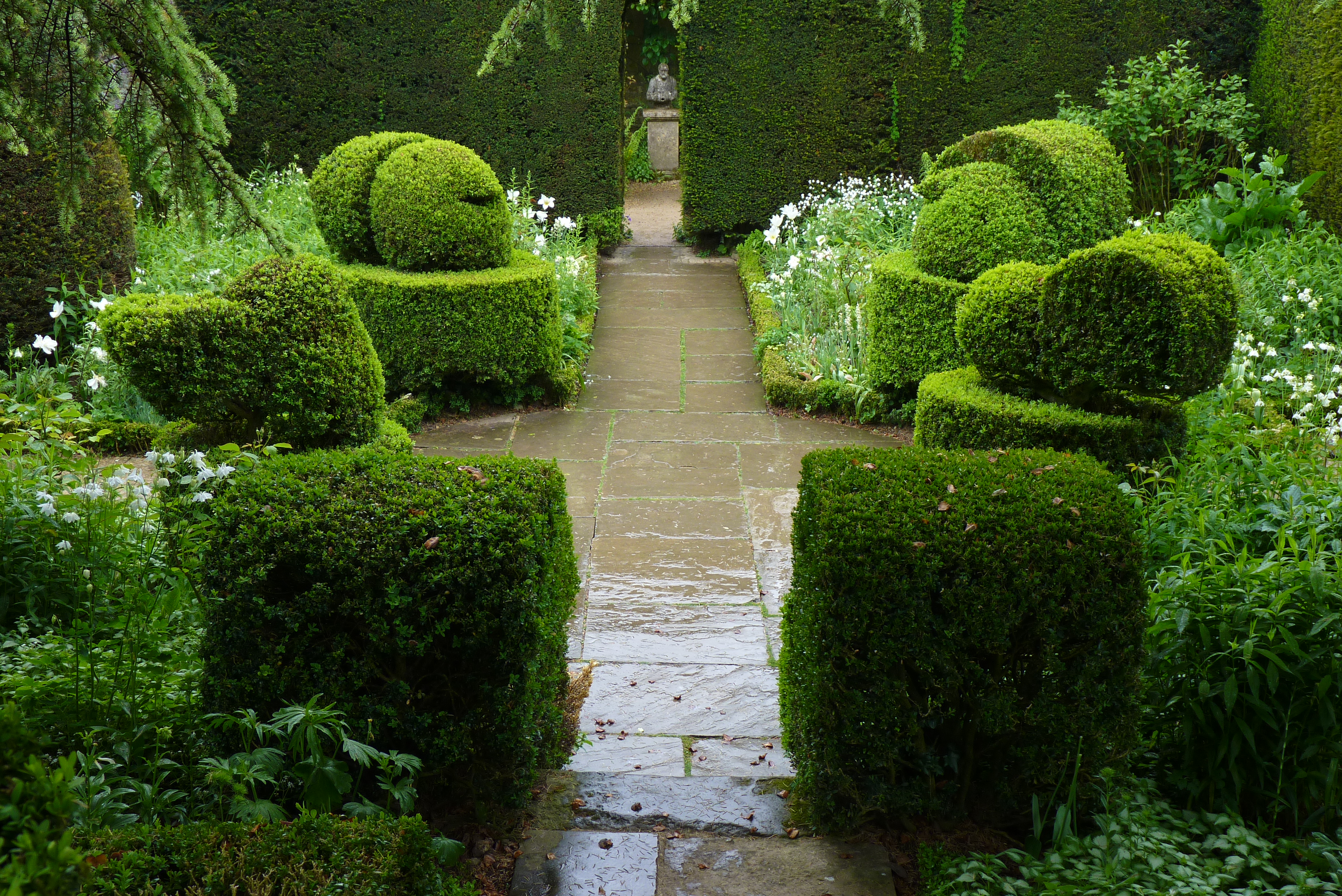
The difference between a path that reads as designed and one that reads as an afterthought is rarely the material. It is almost always a matter of proportions and spatial positioning — the relationship between path width and the space it moves through, between the path's direction and the larger garden axes, and between the walking surface and the planting that flanks it.
These are decisions that need to be made before the ground is broken. Adjusting a path width by 30 cm once the edging is set and the base is compacted is not a minor revision — it is effectively starting again. The time to work through the spatial logic is at the plan stage, ideally with the garden staked out on site so the lines can be walked before they are committed.
Path width conventions
The standard residential garden path — connecting a gate to a front door, running along the side of a house, or linking zones within a rear garden — is typically 0.9–1.2 m wide. That width accommodates a single person carrying bags, allows two people to pass with minor adjustment, and looks proportionate in a domestic setting.
A primary garden path — one that a garden's layout clearly leads toward, or one that functions as the central connecting route — reads better at 1.5–1.8 m. At this width, two people can walk side by side without crowding, and the path registers as a deliberate spatial element rather than a service route. Below 0.9 m, paths begin to feel constrained and are difficult to maintain without damage to adjacent planting.
These figures are not rules — they are the widths that tend to look considered rather than arbitrary. A path of exactly 1.0 m may be right for one garden and clearly wrong for another, depending on what runs beside it. The test is whether the path width relates logically to the space it crosses: a 1.0 m path through a 3 m courtyard reads very differently from the same path across an open 15 m lawn.
Axis and direction
A formal garden layout is organised around axes — typically one primary axis running perpendicular to the house, and one or more secondary axes crossing it. Paths follow those axes and reinforce them. The clarity of the axial structure determines whether the garden reads as orderly or confused, and it is most easily established by identifying the terminal points first: what is the path going toward?
A path that terminates at a gate, a seat, a water feature or a specimen tree has a clear purpose and a defined end. A path that fades into lawn or disappears behind a hedge without resolution creates visual uncertainty — the eye follows the path expecting an answer and finds none. Where a natural terminal point does not exist, creating one (a container, a piece of sculpture, a focal plant) is a more effective solution than adjusting the path itself.
Curved paths
A curved path through a naturalistic or informal garden is not simply a straight path bent — the curve needs its own logic. The most common error is a path that curves for no discernible reason in a space where a straight line would be more efficient. Curves are appropriate when they follow a contour, circumnavigate a planted area, or create a deliberate sense of delayed arrival.
Gentle, consistent curves read as intentional. Tight, compound curves — especially on a main garden path — are difficult to execute in hard paving and tend to look uncomfortable when viewed from above. When in doubt, increase the radius. A curve with a radius of 4–6 m will feel natural underfoot and look considered from the house; a curve with a 1.5 m radius will look like an obstacle course.
Path edges and planting integration
The relationship between a path edge and adjacent planting is one of the places where garden design decisions have the most visible effect over time. A path with a hard edge — a raised kerb, a metal edging or a mowing strip — requires planting to be deliberately placed at a distance. A path with a soft edge, where paving meets soil directly, invites plants to grow over the margin and creates a more relaxed character.
Neither approach is inherently better, but mixing them within the same garden creates visual inconsistency. If the main path to the front door has a clipped box border and a crisp stone edge, the informal gravel path through the kitchen garden should probably still have some degree of edge definition — perhaps a metal strip — even if the planting itself is looser.
Planting alongside paths in Poland needs to account for winter access: a perennial border that reaches 1.2 m across by July will encroach significantly onto a 1.0 m path and may need cutting back for safe winter use. That is not an argument against generous planting — but it is an argument for paths that are wide enough to tolerate it.
Working from a plan
Garden paths are most usefully designed at a scale of 1:50 or 1:100 on paper before any ground is marked. At that scale, a 1.2 m path occupies 2.4 cm on the drawing, which is narrow enough to look very minor — and this is a common source of errors in garden planning: paths look wider than they will feel on the ground.
A reliable test is to mark the path width with spray paint or sand on the actual ground surface and walk it before construction begins. The plan and the reality frequently differ in useful ways — a path that looks generous on paper often reads as narrow in the garden, particularly where planting is already established on either side.
For technical guidance on path and landscape layout in Poland, the Polish Association of Landscape Architects publishes professional standards references relevant to residential garden design.